

Table of Contents
ToggleDoctor-Supervised Ayurvedic Panchakarma Therapy for Mental Calm & Nervous System Balance
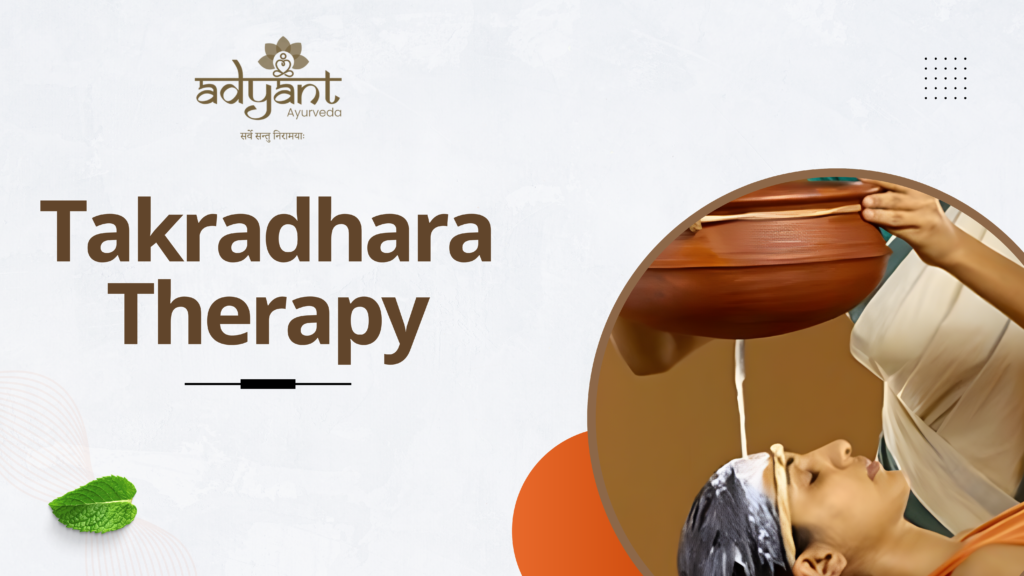
Takradhara is a type of Shirodhara, but specifically done with medicated buttermilk (Takra). It is a classical Ayurvedic Panchakarma therapy that plays a powerful role in calming the mind, balancing the nervous system, and supporting overall mental well-being. In this therapy, doctors gently pour medicated herbal buttermilk (Takra) in a continuous, rhythmic stream over the forehead, scalp, or selected body areas.
At Adyant Ayurveda, Takradhara is delivered strictly as a doctor-supervised medical therapy, not as a spa or relaxation service. Every step follows authentic Ayurvedic texts, ethical clinical standards, and patient-first safety protocols.
📞 Call: 9972541009 to book an appointment
Available at:
What is Takradhara Therapy in Ayurveda?
Takradhara is derived from two Sanskrit words:
Takra – Medicated buttermilk
Dhara – Continuous flow
In this therapy, freshly prepared herbal Takra flows steadily over the forehead or body while the patient rests on a traditional Panchakarma droni.
Unlike oil-based Shirodhara, Takradhara has a cooling and stabilizing effect, making it especially suitable for Pitta-related disorders, stress conditions, and heat-induced imbalances.
Takradhara works best when combined with doctor-prescribed Ayurvedic medicines, dietary corrections, and lifestyle guidance. At Adyant Ayurveda, therapy plans are integrated—not isolated.
Takradhara Under Moordhni Taila (Classical Context)
Classical Ayurveda classifies Takradhara under Chaturvidha Moordhni Taila—a group of specialized head therapies that directly influence the brain, nervous system, sensory organs (Indriyas), and mental health.
Among all Dhara therapies, Takradhara is considered superior for conditions involving Vata-Pitta imbalance and psychosomatic disorders, especially where stress and heat play a major role.
Classical Ayurvedic Basis of Takradhara
Takradhara is described under Dhara Chikitsa in classical Ayurvedic texts, where Takra is indicated for disorders caused by aggravated Pitta and Vata dosha.
Traditionally, Takra is recommended for:
Shiroroga (head disorders)
Manasika roga (mental disturbances)
Daha (burning sensations)
Nidranasha (sleep disorders)
Amalaki-processed Takra is valued for its cooling, stabilizing, and mind-calming properties, strengthening both safety and therapeutic authenticity.
Who Should Consider Takradhara Therapy?
Takradhara may be beneficial for individuals who:
Experience chronic stress, anxiety, or emotional exhaustion
Have disturbed sleep despite medication
Suffer from frequent headaches or migraines
Live or work in high-stress or high-heat environments
Experience irritability, heat intolerance, or burning sensations
Have stress-related blood pressure fluctuations
👉 A doctor consultation is essential before starting therapy.
Why Choose Takradhara at Adyant Ayurveda?
Takradhara at Adyant Ayurveda follows a clinical Panchakarma model, not a commercial wellness approach.
Why Patients Trust Adyant Ayurveda
- Treatments guided by the best Ayurvedic doctors in Bangalore
- 28+ years of senior-doctor clinical experience
- 15000+ Patients treated
- Individualized therapy based on Prakriti & dosha assessment
- Fresh, classical preparation of medicated Takra
- Hygienic, calm, medically monitored environment
- Integrated care: therapy + medicines + diet + lifestyle
- Ethical practice with no exaggerated or misleading claims
- Award Winner: Excellence in Panchakarma by Times Health & National Ayush Award for Best Ayurvedic Clinic.
Difference B/W – Medical Takradhara vs Spa-Based Dhara
| Aspect | Medical Takradhara (Adyant Ayurveda) | Spa / Wellness Dhara |
|---|---|---|
| Supervision | Ayurvedic Doctor | Therapist only |
| Diagnosis | Detailed dosha assessment | Not done |
| Liquid Used | Fresh medicated Takra | Plain buttermilk |
| Customization | Patient-specific | Fixed protocol |
| Purpose | Therapeutic | Relaxation only |
| Safety Standards | High | Often limited |
Classical Takradhara Preparation
Medicated Takra is prepared fresh daily following classical Ayurvedic methods.
Traditional Preparation Methods
Method 1
Amalaki coarse powder boiled in water
Decoction filtered
An equal quantity of sour buttermilk was added
Method 2
Thick Amalaki decoction prepared
Fresh Takra was added and gently churned
Method 3
Milk curdled using herbs like Musta
Amalaki decoction added
Churned to obtain medicated Takra
Doctors select the method based on dosha imbalance and treatment goals.
Disease-Specific Customization of Takradhara
In classical practice, Takradhara formulations are modified based on the condition:
Stress & insomnia: Cooling and calming combinations
Hair fall & premature greying: Scalp-nourishing formulations
Psoriasis & inflammatory skin conditions: Ekanga Takradhara
Children & neurological cases: Only selected formulations under strict supervision
⚠️ No single formula is used for all patients.
Takradhara Procedure – Step-by-Step
1. Purva Karma (Pre-Treatment)
Detailed consultation and diagnosis
Assessment of Prakriti and dosha imbalance
Explanation of therapy and expectations
Preparation of the therapy room and medicated Takra
2. Pradhana Karma (Main Procedure)
Patient lies on the Panchakarma droni
Mild massage if indicated
Takra flows through a cotton wick
Rhythmic movement over the forehead/scalp
Duration: 45–60 minutes
3. Paschat Karma (Post-Treatment)
Excess Takra was gently wiped
Cooling herbal applications if required
Adequate rest advised
Warm water bath after a suitable interval
How Takradhara Treatment Works
Ayurvedic Perspective
Balances:
Prana Vayu – mental activity & nervous control
Sadhaka Pitta – emotions & intellect
Tarpaka Kapha – nourishment of brain tissues
Stimulates vital Marma points, promoting deep mental calmness.
Scientific Insight (Supportive Understanding)
Continuous rhythmic pouring over the forehead may influence the autonomic nervous system, helping reduce stress response, improve sleep rhythm, and enhance relaxation. The cooling nature supports conditions linked to heat and inflammation.
Benefits of Takradhara Therapy (Doctor-Supervised Supportive Care)
Mental & Nervous System
Helps reduce stress, anxiety, and mental fatigue
Supports better sleep quality
Promotes emotional balance
Cardiovascular & Stress-Related Support
Assists nervous system relaxation
Supports stress management in hypertension (adjunct care)
Hair & Scalp Health
Helps manage premature greying, hair fall, and scalp inflammation
Improves scalp comfort
Metabolic & Nerve Health (Supportive)
Supports diabetes care alongside medical treatment
May help relieve burning sensation in diabetic neuropathy
Cognitive & Emotional Well-Being
Supports memory, focus, and clarity
Helps manage mild depressive symptoms as part of integrated care
⚠️ Takradhara is supportive, not curative or a replacement for medical treatment.
Conditions Where Takradhara is Recommended
- Mental & Nervous System: Stress, anxiety, insomnia, burnout
- Hypertension Support: Stress-related BP fluctuations
- Head & Neurological: Migraine, tension headaches
- Skin, Scalp & Hair: Psoriasis (Ekanga), dandruff, hair fall, premature greying
Types of Takradhara
Shiro Takradhara – Forehead & scalp
Sarvanga Takradhara – Whole body
Ekanga Takradhara – Localized application
Takradhara vs Shirodhara
| Aspect | Takradhara | Shirodhara |
|---|---|---|
| Liquid | Medicated buttermilk | Medicated oil |
| Nature | Cooling | Nourishing |
| Best For | Pitta disorders, stress | Vata disorders |
| Climate | Hot seasons | Cooler seasons |
Treatment Duration & Course
Session: 45–60 minutes
Course: 7–14 days
Ideal Time: Morning (7:00–10:00 AM)
Evening sessions (4–6 PM) may be advised in selected cases.
Pathya & Apathya (Diet) During Treatment
Recommended (Pathya)
Warm cooked food, rice, wheat, green gram, old grains, ghee (moderate), boiled buttermilk, gooseberry, plantain.
To Avoid (Apathya)
Spicy, sour, fermented food, alcohol, smoking, curd, fish, black gram, late nights, excess screen time, heavy exercise.
Safety, Contraindications & Possible Effects
Avoid or Postpone If You Have
Fever or infection
Severe cold or sinus congestion
Severe anemia or extreme weakness
Active scalp wounds
During menstruation
Medical emergencies
Possible Mild Effects
Temporary cold sensation or shivering
(Managed with proper warming care)
What Takradhara Does NOT Replace
Emergency medical treatment
Prescribed BP or psychiatric medicines
Immediate cure for chronic diseases
What Results Can You Expect?
Immediate: Relaxation, mental calmness, better sleep
Short-term: Reduced stress response
Long-term: Improved nervous system stability with integrated care
⛔ Results vary based on individual constitution and adherence.
Takradhara Treatment Cost in Bangalore
The cost of Takradhara depends on the type of therapy, duration, number of sessions, and individual health condition.
Approximate Cost Range:
Per session: ₹1600 – ₹3,500
Full course (7–14 sessions): ₹14,000 – ₹55,000
💡 Exact cost is finalized only after a doctor consultation and treatment customization.
⚠️ Prices may vary based on therapy type (Shiro / Sarvanga / Ekanga) and associated Panchakarma care.
📞 Call Now at 9972541009 for exact pricing after consultation.
FAQs Related to Takradhara Treatment
What is Takradhara treatment?
Takradhara is a classical Ayurvedic Panchakarma therapy where medicated herbal buttermilk (Takra) is poured in a continuous, rhythmic stream over the forehead or scalp. It is primarily used to calm the mind, balance the nervous system, and manage heat-related (Pitta) imbalances under doctor supervision.
Is Takradhara different from Shirodhara?
Yes. While Shirodhara commonly uses medicated oils, milk, or decoctions, Takradhara specifically uses medicated buttermilk. This gives it a cooling and stabilizing effect, making it more suitable for Pitta-dominant conditions, stress with heat, and inflammatory scalp or skin issues.
Who is Takradhara best suited for?
Takradhara may be recommended for individuals experiencing:
Chronic stress, anxiety, or emotional exhaustion
Sleep disturbances linked to mental agitation
Heat intolerance, irritability, or burning sensations
Frequent headaches or migraines
Stress-related blood pressure fluctuations
A doctor consultation is mandatory to assess suitability.
Can Takradhara help with psoriasis or itchy scalp conditions?
Yes, Takradhara is often used as supportive care in psoriasis, scalp inflammation, dandruff, and itching, especially when symptoms are aggravated by heat. In such cases, Ekanga Takradhara (localized application) may be advised with condition-specific formulations.
Is Takradhara helpful for stress, insomnia, or headaches?
Takradhara is commonly prescribed for stress-related insomnia, mental fatigue, tension headaches, and burnout, particularly when Pitta and Vata are involved. It helps induce mental calmness and supports healthier sleep patterns as part of an integrated treatment plan.
How is Takradhara done at Adyant Ayurveda?
At Adyant Ayurveda, Takradhara is performed as a doctor-supervised medical therapy, not a spa service. Fresh medicated Takra is prepared daily using classical methods. The therapy follows proper Purva Karma, Pradhana Karma, and Paschat Karma, ensuring safety, hygiene, and therapeutic effectiveness.
How long does one Takradhara session take?
A single Takradhara session usually lasts 45 to 60 minutes, depending on the patient’s condition and the doctor’s prescription.
How many days is a Takradhara course?
The typical course ranges from 7 to 14 days. The exact duration depends on the severity of symptoms, chronicity, and individual dosha imbalance.
Do I need to do any preparation before Takradhara?
Yes. Before starting therapy:
A detailed Ayurvedic consultation is done
Diet and lifestyle guidance is provided
Heavy meals before the session are avoided
All preparation is guided by the treating doctor.
What should I avoid after the session?
After Takradhara, patients are advised to avoid:
Spicy, sour, fermented, and very hot foods
Alcohol, smoking, late nights
Excess screen time and heavy exercise
Direct sun exposure immediately after therapy
Following Pathya–Apathya improves outcomes.
Is Takradhara safe for BP patients?
Yes. Takradhara can be safely administered to BP patients under strict doctor supervision, especially when blood pressure issues are stress-related. It is used as supportive care, not a replacement for prescribed medication.
Is Takradhara safe for elderly patients?
Yes. For elderly patients, the intensity, duration, and formulation are adjusted based on strength, digestion, and overall health.
Can children undergo Takradhara?
Takradhara may be advised for children only in selected neurological or stress-related cases and only under strict Ayurvedic medical supervision.
Is Takradhara painful?
No. Takradhara is a gentle, non-invasive, and deeply calming therapy. Most patients experience relaxation during and after the session.
Author & Medical Reviewer
Written By
Dr. Shreya – BAMS
Panchakarma & Lifestyle Disorder Specialist
Adyant Ayurveda, Bangalore
Medically Reviewed By
Dr. Shree Lakshmi – BAMS
Senior Ayurvedic Consultant
28 Years Clinical Experience
Clinical Review Process
This content is periodically reviewed by senior Ayurvedic consultants to ensure accuracy, safety, and classical alignment.
Last Updated: 24 December 2025
Medical Disclaimer
This content is for educational purposes only and does not replace professional medical advice. Panchakarma therapies must be undertaken only after consultation with a qualified Ayurvedic doctor.
References
NIH – Ayurveda Overview, U.S. National Library of Medicine