


Table of Contents
ToggleNatural, doctor-led herbal powder poultice therapy for joint pain, stiffness and mobility — explained simply, with what to expect and when to book.
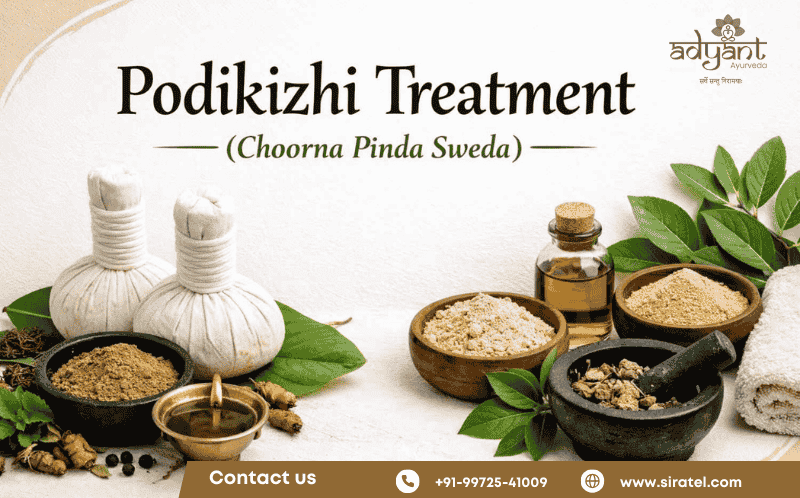
Podikizhi treatment (also called podi kizhi or choorna pinda sweda) is an Ayurvedic Pinda Sweda (bolus fomentation) in which medicated herbal powders are heated, tied into small cloth boluses (kizhi), and rhythmically applied to the body. The combo of warm herbal medicine + friction increases local blood flow, soothes muscles, reduces stiffness and helps clear sticky metabolic waste (ama) from tissues.
Why this matters
If you work long hours, sit a lot, have morning stiffness, or recurring joint pain — podikizhi is a traditional, non-surgical option that targets the root Ayurvedic drivers (mostly Vata and Kapha imbalance) and supports modern goals: pain relief, improved range of motion and reduced dependence on painkillers.
What does Podikizhi actually do?
Think of podikizhi as a warm, herbal compress massage that:
- Delivers therapeutic heat deep into soft tissue — heat opens small blood vessels and increases blood flow to the area. This effect is documented in modern physiology research.
- Adds medicinal herbs (anti-inflammatory, analgesic, decongestant) directly to the skin surface via a hot bolus — herbs are chosen by your doctor for the complaint.
- Produces sweating and lymphatic stimulation, helping clear sticky metabolic residues (Ama) that contribute to pain and stiffness in Ayurvedic understanding.
Modern trials and reviews show localized heat helps pain and function for many musculoskeletal problems, especially when combined with exercise or other therapies. Heat is widely recommended by experts for muscle and low-back pain management.
Therapeutic Uses of Podikizhi
Podikizhi treatment commonly helps people with:
- Osteoarthritis (knee, hip, fingers)
- Chronic low-back pain and lumbar spondylosis
- Cervical spondylosis (neck stiffness)
- Sciatica / neuralgic leg pain (as supportive therapy)
- Frozen shoulder (adhesive capsulitis)
- Muscle strains, chronic tightness and post-exercise recovery
- Early degenerative or inflammatory joint conditions, when combined with medicines
(If you have advanced structural damage, recent fracture, active infection, or uncontrolled medical problems, your doctor will advise alternatives.)
Quick facts at a glance
| Item | What to expect |
|---|---|
| Session length | 30–60 minutes (typical 45 min) |
| Course | 7–14 days (common); chronic cases 14–21 days |
| Sensation | Warm, rhythmic pressing — soothing, sometimes mildly tender |
| Main effect | Reduced stiffness, improved movement, local detox via sweating |
| Common combo | Abhyanga (oil massage) before podikizhi; steam bath after |
| Typical Bangalore price (market range) | ₹1,200 — ₹5,000 per session (varies by clinic & customization). |
The step-by-step podikizhi procedure (what we do at Adyant Ayurveda)
1) Doctor consultation (Prakriti & Vikriti)
We begin with a short Ayurvedic exam: constitution (Prakriti), current dosha imbalance (Vikriti), the stage of disease, and any red flags (fever, open wounds, bleeding disorders, uncontrolled diabetes). This tells the doctor whether podikizhi is right and which churna (powder) and oil to use.
2) Abhyanga (warm medicated oil massage)
Abhyanga is a light, warm, medicated oil massage that opens skin pores and prepares tissue for fomentation. This is standard prior care.
3) Preparation of boluses (pottali / kizhi)
Selected herbal powders (for example, Rasnadi, Kottamchukkadi, Kolakulathadi — chosen to match your dosha/condition) are fried lightly in suitable medicated oil and packed into muslin cloth bundles. Fresh powders are preferred daily.
4) Application (Pradhana Karma)
The therapist heats the bolus (in oil or over a pan), checks the temperature, and rhythmically applies the warm poultice over the affected areas for 30–45 minutes. Boluses are swapped as they cool to maintain steady warmth. The therapist uses pressing, patting and circular strokes as per the classical rhythm.
5) Paschat Karma (post-care)
Area is wiped clean, a short rest is advised, and often a warm steam or hot water bath is recommended. Your doctor may add internal medicines (decoctions, rasayanas) or other Panchakarma like Vasti if indicated.
Types & Customization – why not every podikizhi is the same
Podikizhi is a form of Churna Pinda Sweda. Therapists vary the formula and method depending on what’s dominant:
- Ruksha (dry) podikizhi — powders used dry or with minimal oil; preferred when ama (sticky toxins) and Kapha predominate (e.g., rheumatoid patterns).
- Snigdha (unctuous/oiled) podikizhi — powders fried in oil; used when Vata predominates (degenerative joint pain, dry stiffness).
- Leaf or patra kizhi (ilakizhi) or Navara kizhi (rice bolus) are alternatives for specific indications.
At Adyant Ayurveda we pick powders & oils after a clinical review — that’s the difference between a generic spa bolus and a therapeutic podikizhi.
Benefits – what patients commonly experience
Realistic outcomes you can expect:
- Faster reduction in morning stiffness and improved first-step mobility (often within 5–10 sessions).
- Less pain during daily activities — many patients report meaningful relief when podikizhi is combined with medicines and exercises. (Evidence supports heat therapy improving pain/function when used appropriately.)
- Improved local circulation and tissue warmth (documented physiological effects of localized heat).
- Better sleep and reduced muscle spasm for many patients.
- Skin glow & mild exfoliation from certain herbal powders.
Important: outcomes depend on disease stage, adherence to diet/lifestyle advice, and whether internal medicines or other Panchakarma are used alongside podikizhi.
Contraindications — when to avoid podikizhi
Do not do podikizhi (or only do with strict medical supervision) if you have:
- High fever, acute infection, or active inflammation
- Open wounds, large skin ulcers or severe dermatitis
- Uncontrolled hypertension, severe heart disease, deep vein thrombosis (DVT)
- Recent fracture, severe varicose veins or bleeding disorders
- Pregnancy (generally avoided unless advised by an experienced physician)
- Severe uncontrolled diabetes — proceed only under medical oversight
Always be transparent about medications or chronic illnesses during consultation.
Evidence & how Ayurveda maps to modern science
Two points matter to modern patients:
- Heat increases local blood flow and relaxes muscle — experimental work shows local heating that raises muscle temperature can increase blood flow substantially (examples: muscle blood flow increases ~45% in some controlled studies). This supports why podikizhi’s heat speeds recovery and eases pain. (PMC)
- Clinical reviews indicate local heat applications can improve pain and function, especially for acute musculoskeletal problems; combining heat with exercise or rehab tends to give better outcomes than exercise alone. Expert consensus also strongly supports heat therapy for many musculoskeletal complaints. This aligns with the centuries-old Ayurvedic idea of Swedana (sudation) for Vata/Kapha disorders. (ScienceDirect)
In short: podikizhi’s classical rationale (heat + medicine to clear Ama, reduce Vata/Kapha) has physiological mechanisms we can measure today (blood flow, reduced muscle tone, improved local metabolism), and clinical studies of heat therapies back up many of the symptomatic benefits.
Typical course & timeline
| Course length | What usually happens |
|---|---|
| 1–3 sessions | Noticeable warmth, reduced local stiffness; often better sleep |
| 5–10 sessions | Marked reduction in morning stiffness, improved mobility |
| 10–21 sessions | Best for chronic cases; combined with medicines yields longer lasting improvement |
Most patients start with daily sessions for 7–14 days (outpatient). Chronic or complex conditions may need repeat courses or integration with Vasti/Virechana as advised by the doctor.
Diet & lifestyle while you’re undergoing podikizhi
Small changes improve results considerably:
- Eat warm, cooked food (khichdi, soups); avoid cold/raw food.
- Reduce heavy, oily, fried food and excess sweets.
- Light walking or prescribed physiotherapy exercises after therapy helps retain gains.
- Avoid exposure to cold (AC, cold shower) right after a session.
- Stay hydrated; listen to doctor about specific herbal decoctions or powders.
These suggestions are standard Panchakarma common sense: they reduce re-accumulation of Ama and help Dosha balance.
Podikizhi Treatment Cost in Bangalore
The cost of podikizhi treatment in Bangalore at Adyant Ayurveda typically ranges between ₹1,200 to ₹5,000 per session. It depends on the herbs used, session duration, medical supervision, and whether it is combined with other therapies. At Adyant Ayurveda, pricing is personalised after assessing your condition and treatment needs. A consultation is recommended for an accurate estimate.
Podikizhi vs physiotherapy vs injections — where it fits
- Podikizhi: best for pain driven by stiffness, Vata/Kapha imbalance, and soft-tissue problems; conservative, low-risk and holistic.
- Physiotherapy: essential when strength, mobility training and biomechanics are central (often works best combined with podikizhi).
- Injections / surgery: required for structural mechanical failures (advanced cartilage loss, severe nerve compression) — podikizhi may help symptomatically but won’t replace structural interventions when those are needed.
Good outcomes often come from blended care: doctor-led Ayurveda + physiotherapy + lifestyle change.
Real patient questions of Podikizhi Treatment
What conditions does podikizhi help with?
Podikizhi treatment is commonly advised for:
- Osteoarthritis (knee, hip, fingers)
- Rheumatoid arthritis (in controlled stages)
- Cervical spondylosis (neck pain)
- Lumbar spondylosis (low back pain)
- Sciatica
- Frozen shoulder
- Muscle stiffness and sports injuries
It works best in Vata and Kapha dominant conditions involving stiffness and pain.
What happens during the session?
At Adyant Ayurveda, the procedure usually includes:
- Consultation – Doctor checks your body type (Prakriti) and condition.
- Abhyanga (oil massage) – Warm medicated oil prepares the body.
- Podikizhi application – Heated herbal bundles are applied for 30–45 minutes.
- Rest period – Short relaxation after therapy.
You may be advised a warm bath afterward.
How many sessions are required?
This depends on the condition.
- Mild pain → 5–7 sessions
- Chronic stiffness → 7–14 sessions
- Long-standing arthritis → 14–21 sessions (with internal medicines)
Your doctor will decide the course based on severity.
When will I see results?
Many patients feel lighter and less stiff within 3–5 sessions. For chronic problems, improvement is gradual. Best results are seen when therapy is combined with Ayurvedic medicines and lifestyle changes.
Is podikizhi a massage?
Not exactly. Although it involves rubbing and pressing, podikizhi treatment is a therapeutic medical procedure, not a spa massage. It is done under medical supervision.
Can podikizhi cure arthritis?
Podikizhi significantly reduces pain and stiffness. However, in advanced arthritis with structural damage, it may not reverse joint changes. It works best as part of a complete Ayurvedic treatment plan.
What should I avoid after treatment?
After podikizhi treatment:
- Avoid cold exposure
- Avoid cold drinks and refrigerated food
- Avoid heavy or fried meals
- Avoid immediate strenuous activity
Warm, light food and rest improve results.
Is podikizhi safe?
Yes, when performed by trained therapists under the guidance of an experienced Ayurvedic doctor.
At Adyant Ayurveda, each patient is assessed before starting therapy.
Why choose Adyant Ayurveda in Bangalore (the real difference)
- Doctor-led plans: Every podikizhi course starts with a physician assessment (Prakriti/Vikruti), not just a spa booking.
- Customized churnas & oils: Powders and oils selected for your dosha & condition — not off-the-shelf boluses.
- Fresh preparation: Boluses prepared daily from quality herbs; therapist-to-patient ratio kept low for careful temperature control.
- Integrated care: We add internal decoctions, physiotherapy or Panchakarma support when clinically indicated.
- Local understanding: We design plans that fit Bangalore life — desk jobs, long commutes, and seasonal factors that worsen Vata/Kapha.
When to book — simple red flags
Book an assessment if you have:
- Morning stiffness >30 minutes
- Pain that limits walking or climbing stairs
- Persistent neck pain from laptops or phone use
- Recurrent sciatica with leg pain or numbness
- Knee pain that’s not improving with rest and activity tweaks
Early care usually means a shorter, more effective course.
How to prepare for your first visit
Bring:
- Current medicines list
- Any imaging if available (X-ray/MRI for chronic joint/back cases)
- Short history of the problem (onset, triggers, previous treatments)
Expect a 20–30 minute consultation followed by a therapist-led session if agreed.
Final word — sensible expectations
Podikizhi is neither a miracle nor a placebo. It’s a time-tested Ayurvedic fomentation therapy with clear mechanisms (heat, herbs, circulation), real patient benefits, and a place in modern multimodal care for musculoskeletal pain. When performed by qualified doctors and therapists, and combined with appropriate medicines and lifestyle changes, podikizhi can noticeably reduce stiffness, improve movement and lower pain medication dependence for many patients.
Book a consultation (Adyant Ayurveda Bangalore)
If you’re in Bangalore and want a doctor-led podikizhi treatment plan, contact Adyant Ayurveda for an assessment. We’ll check suitability, explain the course options and give a clear cost estimate before therapy starts.
Call us at +919972541009 and Whatsapp us at – +919972581009 Or Book online at our website / walk in for an initial consultation.
References
EasyAyurveda — Podikizhi (Churna Pinda Sweda) overview and classical procedure. (Easy Ayurveda Hospital)
Adyant Ayurveda — Pinda Sweda overview. (Adyant Ayurveda)
Heinonen I. et al., local heating increases muscle blood flow (experimental study). (PMC)
Clijsen R. et al., Local Heat Applications as a Treatment (review — positive effects on pain/function). (ScienceDirect)
Mayer JM. et al., continuous low-level heat wrap + exercise for acute low back pain — improved outcomes vs exercise alone. (thespinejournalonline.com)
Educational Disclaimer: This article is for educational purposes only and does not replace medical advice. Treatment results may vary. Please consult a qualified Ayurvedic doctor or healthcare professional before starting any treatment.
Last Updated: 11 February 2026
Content Update Policy
Our articles are reviewed and refreshed regularly to reflect the latest information. Our experts continuously monitor developments in the health and wellness field to ensure the content remains accurate and up to date.
Author: Dr. Shree Lakshmi, BAMS
Senior Ayurvedic Physician, Adyant Ayurveda
Medical Reviewer: Dr. Sumana Patvardhan, MD (Ayurveda)
Consultant Ayurvedic Physician, Adyant Ayurveda